Energy Security Insights
The Datasheet Illusion: Why Verified Specs Matter More Than Printed Promises
Printing a PDF is cheap. Engineering a product that actually survives 10 years in the field is expensive. Here is how to spot the difference.
You have three PDFs in front of you from three different suppliers. They all list the exact same specifications: LiFePO4, 6000 Cycles, 5.5KW Output, Grade A Cells.
Yet, Supplier C is 30% cheaper than Supplier A. Is Supplier C a miracle worker? Or is Supplier A overcharging?
At EnerVerge, our independent quality evaluation data suggests a third reality: One of these datasheets is likely an illusion. Here is how the numbers on the page often hide the risks in the field.
1) The “Lab Condition” Trap: Why 6000 Cycles ≠ 10 Years
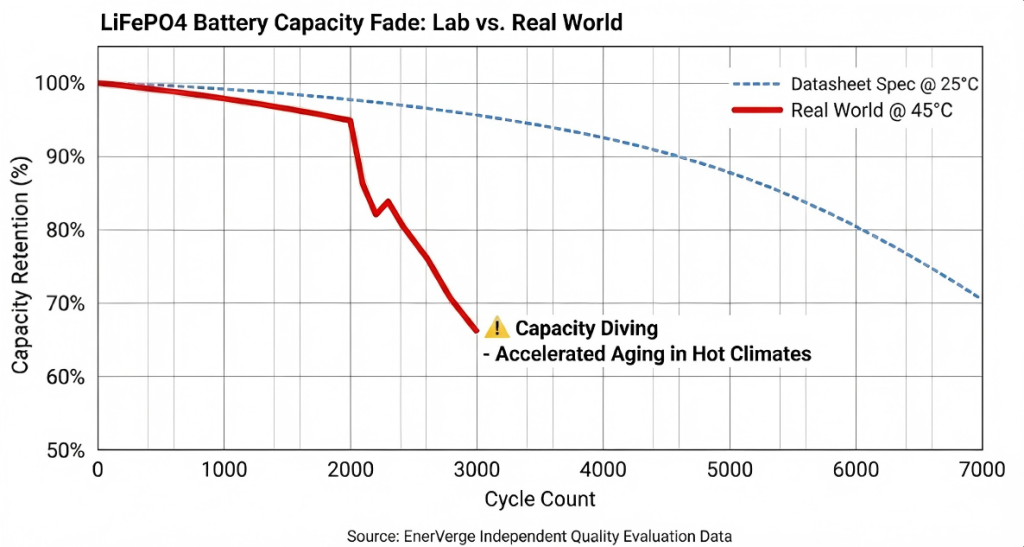
Every manufacturer claims “6000+ cycles” for their LiFePO4 batteries. But you need to read the fine print—or the lack thereof. Most datasheet tests are performed in a “Golden Environment”: 25°C controlled temperature with a gentle 0.5C charge/discharge rate.
The Reality Check: If your project is in Thailand or Nigeria, your batteries aren’t living in a lab. They are facing ambient temperatures of 35°C to 45°C. Without rigorous thermal management, a generic “6000 cycle” battery can lose 20% of its capacity in less than two years.
2) The Inverter “Peak” Power Game
Let’s look at a common spec: 5.5KW Rated Power. On paper, a generic inverter looks identical to a high-quality one.
However, “Rated Power” is often treated as “Peak Power” by lower-tier manufacturers. A poorly designed inverter with undersized heat sinks will hit thermal limits within 10 minutes of running a heavy load. To protect itself, it throttles (derates) down to 4KW. You paid for 5.5KW, but on a hot afternoon, you only get 4KW.
!The Cost of “Cheap”: When you buy based on the datasheet alone, you are not saving money; you are deferring cost. The $200 you save today becomes a $500 service trip next year.
3) The “Grade A” Shell Game
“Grade A Cells” is the most abused term in the industry. Every supplier claims to use them. So why do we see swollen batteries and voltage imbalances after 6 months?
There is a massive gray market for “Grade B” or “down-spec” cells. These cells might pass a single capacity test (the Golden Sample), but they lack internal resistance consistency. In a 51.2V system, just one inconsistent cell drags down the entire pack.
4) The Hidden Cost of “Cheap” Specs
At EnerVerge, we act as the gatekeeper between the factory floor and your project site. Our EQA™ (Independent Quality Assurance) process is designed to filter out these “Datasheet Illusions.”
We prioritize verified supply chains—like using authentic BAK 100Ah Grade A cells—and conduct batch consistency verification. We are looking for the 0.05V variance that the brochure hides.
Conclusion
Anyone can print a beautiful datasheet. But only a few can sign a quality guarantee verified by independent stress testing.
Don’t let your project become a testing ground. We believe that trust is good, but independent verification is better.